
SPACE EXPERIENCE DESIGN AND ARTISTIC RESEARCH
Miding the space.
Designing for experience.
Before a space is understood, it is already felt. Atmosphere precedes form. The acoustic character of a material, the social memory of a ground, the ecological rhythm of a landscape - these are the conditions that define how a space is perceived. The practice is built on sensorial awareness: entering a place through the senses, exploring what is already there and designing from the inside out - materialising the forces that shape perception, emotion and atmosphere into spatial and visual form. The result is environments that do not perform but respond - experientially rich, that challenge perception, engage people and deepen their connection to the spaces around them over time.
-
Oana-Maria Paraschiv is a spatial experience designer working across public spaces, landscapes, interior and immersive environments - using a consistent methodology that reads the sensory and atmospheric conditions of a place and translates them into spatial narratives across different scales and disciplines, engaging the senses, bridging the physical and the digital and making people more present and connected with the spaces around them.
-
Reading comes before designing. Every project begins with a direct encounter with the space and its conditions - what the body registers before the mind analyses, what is already present and waiting to be worked with rather than overwritten. From that reading, a spatial narrative is informed and developed, as well as every decision that follows - layout, material, threshold, light, sound, sequence, digital layer. Sensory and spatial are inseparable from the first line drawn to the final detail.
Underlying every project is a conviction about how space and human experience are connected:
experience → reaction → thought → emotion → embodied action → spatial form → exposure → new experience
This cycle is the engine of the practice. A space designed through this process does not impose an experience - it creates the conditions for one, challenging perception, facilitating connection, collective memory and growing richer with time.
Projects are developed in close collaboration with clients, curators, producers, architects and technical teams - translating ambiguous briefs into clear spatial concepts and communicating experiential intent across disciplines through drawing, model, visualisation and written narrative. Real-time visualisation tools, 3D modelling and generative AI are part of the design language: instruments for making spatial conditions visible before they are built and for bridging physical environments with digital experience.
-
With over 10 years of professional experience across Karres en Brands, Flux Landscape Architecture, West 8, Urban Power, NordiQ-Group and RE-ACT Now, and through an active independent research practice developed through international residencies and artistic projects, the practice operates across four interconnected areas - united by a consistent methodology and three questions that go beyond any brief:
How is this space or form already felt and perceived?
How should it be felt and perceived?
How can design make that possible — and sustain it over time?
At urban and landscape scale, the design forces are collective movement, ecological process and cultural memory embedded in ground. At interior and installation scale, they are material surface, acoustic behaviour, light quality and bodily orientation. The questions change register; the method does not.
SPATIAL EXPERIENCE DESIGN — immersive environments, exhibitions, installations and experiential concepts. Designed for presence: how a space is entered, inhabited, felt and remembered.
INTERIOR & BRAND ENVIRONMENTS — hospitality, retail and cultural interiors where identity and human behaviour are translated into atmosphere. Environments that engage rather than perform.
LANDSCAPE & PUBLIC REALM — public spaces, placemaking strategies and regenerative landscapes designed around collective memory, social choreography and ecological process.
RESEARCH & PROTOTYPING — sensory mapping, material experimentation, speculative design and emerging spatial futures. The laboratory of the practice - where methods are tested before they become projects.
-
SPATIAL & EXPERIENCE DESIGN Spatial Experience Design, Experiential Design Immersive, Environment Design, Exhibition Design, Interior Design, Sensory Design, Atmospheric Design, Placemaking, Public Space Design, Landscape Architecture, Urban Planning, Masterplanning
RESEARCH & METHODOLOGY Artistic Research, Phenomenological Site Analysis, Atmospheric Mapping, Sensory Mapping, Material Experimentation, Speculative Design, Research & Prototyping, Soundscape Design, Mixed Media
DESIGN PROCESS & DELIVERY Concept Development, Spatial Storytelling, Schematic Design, Design Development, Technical Documentation, Competition Design, Client Brief, Management, Team Leadership, Cross-disciplinary Collaboration, Tender Preparation, Community Engagement, Participatory Design
VISUALISATION & COMMUNICATION 3D Modelling, Generative Visualisation, Physical Model Making, Visual Storytelling, Presentation Design, Collage & Moodboard Design, Technical Drawing, Graphic Design, Illustration, Photography, Photo Post-Production, Publication Design
SOFTWARE Rhino 3D, Grasshopper, AutoCAD, SketchUp, Blender, TouchDesigner, Adobe Illustrator, Adobe Photoshop, Adobe InDesign, After Effects, GIS, Generative AI Tools
ANALYSIS & PLANNING Spatial Analysis, Urban Analysis, Morphological Analysis, GIS Mapping, Qualitative Research, Quantitative Research, Climate Adaptation, Ecological Design, Water Management, Mobility, Planning
Areas of Practice
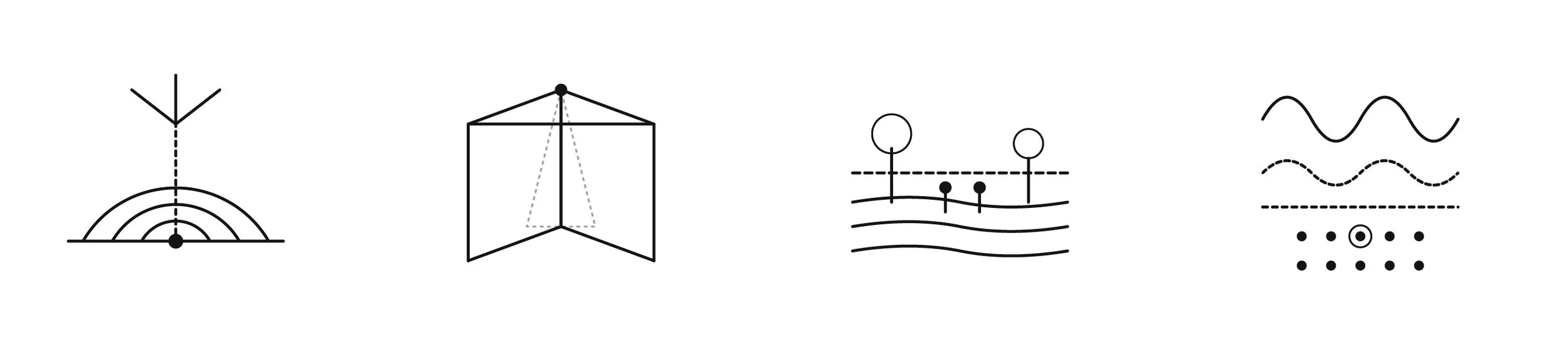
SPATIAL EXPERIENCE DESIGN | Immersive environments, exhibitions, installations and experiential concepts. Designed for presence — for how a space is entered, inhabited, felt and remembered. The focus is on sensory sequence, atmospheric logic and the human journey through space.
INTERIOR AND BRAND ENVIRONMENTS | Hospitality, retail and cultural interiors where identity and human behaviour are translated into atmosphere. Environments that engage rather than perform — where material, light, sound and spatial organisation create conditions for connection, discovery and return.
LANDSCAPE AND PUBLIC REALM | Public spaces, placemaking strategies and regenerative landscapes. Outdoor environments designed around collective memory, social choreography and ecological process — spaces that respond to the people who inhabit them and to the natural forces that move through them over time.
RESEARCH AND PROTOTYPING | Sensory mapping, material experimentation, speculative design and emerging spatial futures. The laboratory of the practice — where methods are tested, tools are developed and questions are posed before they become projects.
Services

Available for freelance collaboration with experience design studios, cultural institutions, brands, developers and municipalities.
SPATIAL EXPERIENCE CONCEPT DEVELOPMENT | From brief to spatial narrative - atmospheric logic, sensory sequence, material language and human journey communicated through drawings, models, visualisation and written narrative. For pitches, competitions and early-stage development.
IMMERSIVE & EXHIBITION DESIGN | Concept and design development for immersive installations, exhibition environments and brand experiences - light, sound, material, sequence and digital layer working as a coherent experiential whole.
INTERIOR & BRAND SPACE DESIGN | Spatial design for hospitality, retail and cultural interiors - identity and programme translated into atmosphere, from concept through to detailed spatial proposal and material specification.
PUBLIC SPACE & LANDSCAPE DESIGN | Experiential and sensory design for public spaces and regenerative landscape environments. Full process from SO through DO, with specialist capability in atmosphere, collective life and ecological responsiveness.
PHENOMENOLOGICAL SITE ANALYSIS & ATMOSPHERIC MAPPING | A specialist research methodology for reading the sensory and atmospheric conditions of a place - acoustic behaviour, light quality, material character, social rhythm, ecological process - and translating them into spatial design input. Available as a standalone commission or as the foundation phase of a larger project.
SPATIAL ANALYSIS & SITE RESEARCH | Comprehensive site-specific analysis across urban, landscape and interior scales - combining qualitative and quantitative methods. Physical and morphological analysis, GIS mapping, spatial data visualisation, atmospheric and sensory mapping and technical site documentation using CAD, Rhino and GIS. Delivered as research reports, diagrams, plans and visual narratives for design teams, developers and municipalities.
GENERATIVE SPATIAL VISUALISATION | Spatial and sensory research translated into three-dimensional visualisations and real-time generative environments using 3D modelling, TouchDesigner and AI tools. Full post-production capability across 2D technical drawings, plans and sections at every project phase, axonometric views, rendered visualisations and photography editing - for installations, competitions, presentations and immersive storytelling.
VISUAL STORYTELLING & PRESENTATION DESIGN | Spatial concept communication through moodboards, diagrams, collages, illustrations and written narrative — including graphic design for booklets, posters, brochures and exhibition materials. Photoshop-based image making, photography post-production and visual identity support. Available as a standalone service for studios, agencies and developers.
Research
Alongside commissioned work, an active independent research practice investigates a question that runs beneath all of it: how do the invisible forces that define the atmosphere of a place become the generative material of its spatial form?
The research moves between two modes. The first is field-based and phenomenological - entering a place through direct sensory encounter, collecting what cannot be surveyed. Sound recorded as terrain. Force traced in material. Ecological rhythm observed as design input. The second is experimental and material - testing in the studio what the field has raised, through ceramics, wire, mixed media, generative visualisation and real-time computation. Together these modes produce a practice that moves fluidly between observation and making, between the measurable and the felt, between spatial design and artistic research.
What the research keeps returning to is the body as the primary instrument of spatial knowledge and the idea that spaces designed from that starting point are fundamentally different from spaces designed from plan and section alone. They are spaces that breathe. That remember. That change.
BEYOND BORDERS: SOUNDSCAPES OF ZANZIBAR AND SRI LANKA Field recordings translated into composite three-dimensional sonic terrain. Sound treated as geological data: frequency as depth, amplitude as elevation, silence as form. A methodology for mapping collective memory as spatial experience, developed across two continents.
SLOWFLOW — MIND THE SPACE A phenomenological field model mapping the atmospheric forces of a rapidly transforming urban district. Wind pressure, acoustic reflection, thermal radiation and material surface behaviour translated into tangible form. An argument, pressed into wood and wire and granular matter, for deceleration as a design methodology: slow down to feel what is already there. Prix de Rome 2026 entry.
ATMOSPHERIC MORPHOLOGIES The city read as a sensory field. Air, water, surface and ground translated into layered material on canvas. A single red organic element - the only warm presence, the only thing that resists the logic of system and marks the point where the city stops being an external fact and becomes an internal experience.
CLAY TRAJECTORIES Terracotta holds the trace of force. Wire carries it outward, past the boundary of the object, into the surrounding space. What the hand pressed into the clay, the eye continues into the room.
These threads are not parallel to the commissioned practice, they feed it. The research is the laboratory in which the methods are developed, tested and refined before they become spatial proposals. The artistic and the professional are not two separate tracks. They are the same practice, moving at different speeds.
Recognition
Prix de Rome 2026 — Entry, Terminal Velocity, Architecture category
Rijksakademie Residency 2027 — Open Call submission
Fondazione Studio Rizoma — Open Call selection, Palermo, 2025
Art Hub Copenhagen — SciArt Residency Open Call, 2025
STAWI Residency — Beyond Borders, Zanzibar, 2024
4th place — Reactor/Rulmentul Competition, Brașov, Romania, 2024
1st place — Physical Model Contest, Aalborg University, Denmark, 2016
3rd place — MTR National Traditional Design Competition, Bucharest, 2013